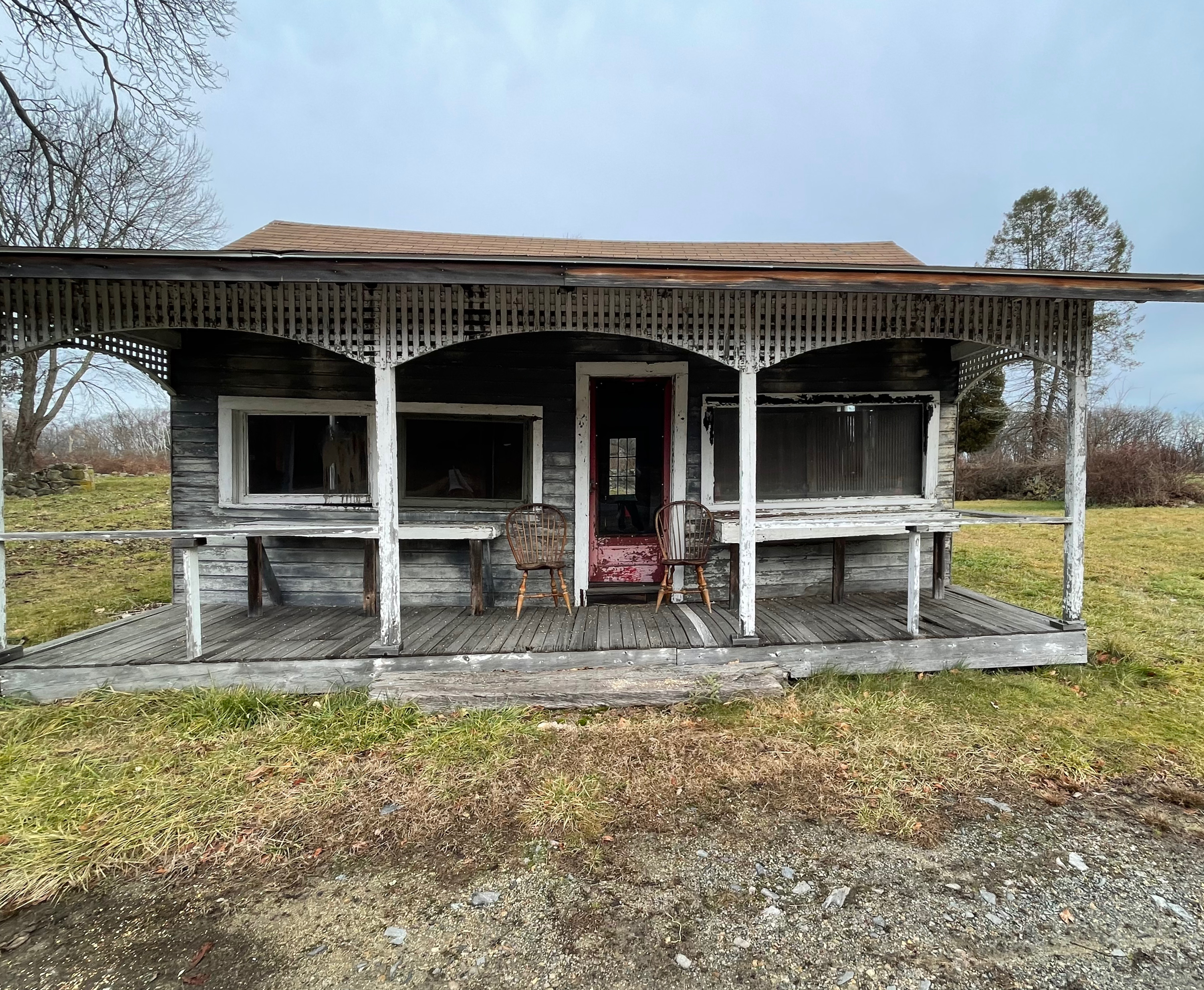
The Albano Produce Stand
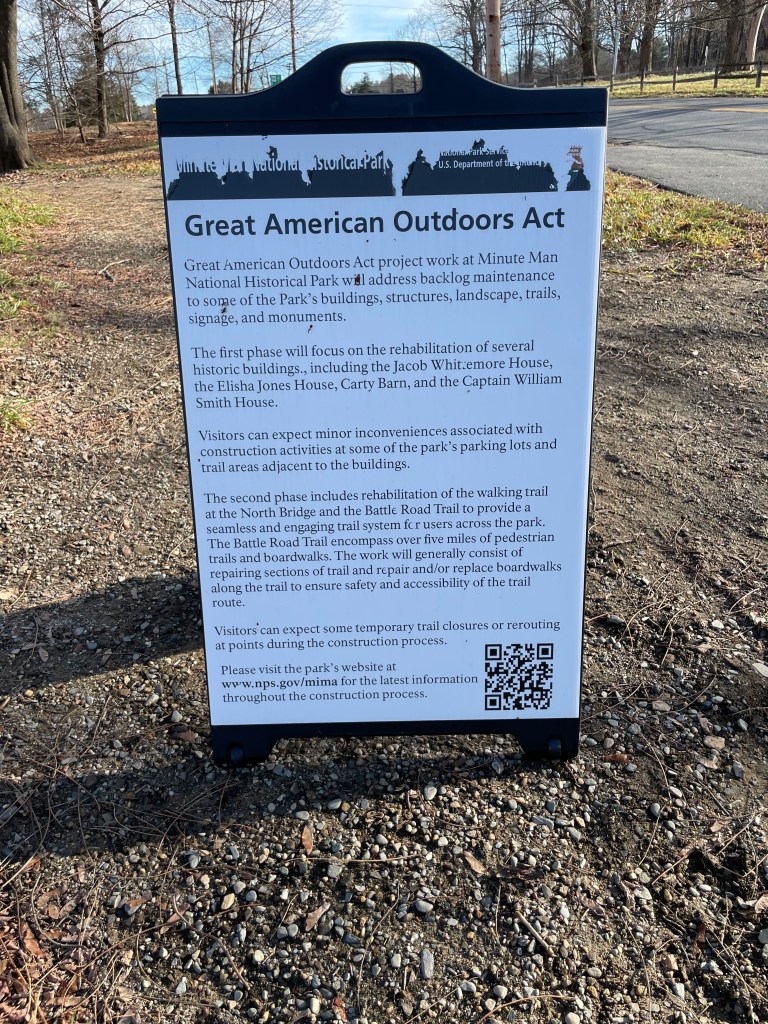
On a rainy Sunday afternoon in the beginning of December, after meeting a friend for tea in Lexington Center, I veered to the right onto Lexington Road to head home via Concord Center. For years, I have been fascinated with the farm stands that line that part of Lexington Road (https://waitingstories.org/2019/03/09/the-forgotten-farmstand/) but on this , along the road, many of the older buildings and one of the other farm stands had orange fencing around it with a sign saying CSS Project. The sign went on to discuss that the projects were funded by the Great American Outdoors Act and that the project work at Minuteman National Historical Park will address backlog maintenance to some of the Park’s buildings, structures, landscape, trails, signage and monuments. It went on to describe that the first phase would focus on the rehabilitation of several historic buildings. I have always been curious about some of the older homes around this stretch and why they aren’t used for seemingly anything, but perhaps this was the start to repurpose these buildings. From the Minuteman National Park website (https://www.nps.gov/mima/mima-gaoa.htm), the Park Superintendent, Simone Monteleone, describes the project as “These repairs ensure that Minute Man National Historical Park will have the ability to continue sharing important historical stories about the causes and consequences of the American Revolution. The Park will be ready to welcome visitors for the 250th anniversary for the opening of the American Revolution in April 2025.” The webpage also describes “Additional work will take place throughout the park continuing into 2025, the 250th anniversary year of the opening battle of the American Revolution. Improvement projects include historic structures and landscape improvements, such as preserving stone walls and improving views and vistas. Additional work will enhance the elements of this locally significant landscape to reveal the agricultural history of Massachusetts in the 18th, 19th and 20th centuries by replanting and vegetation maintenance and improved wayfinding signage.” I did a little more research on this project and found a letter from the Park Superintendent to the Concord Town Manager describing this project and how many of the buildings will be repurposed into single family housing (https://concordma.gov/DocumentCenter/View/37453/20220330_MIMA_GAGO_S106_ReviewPackage_Concord_for-Signature) However, one line did make me pause: “Buildings proposed for demolition…”
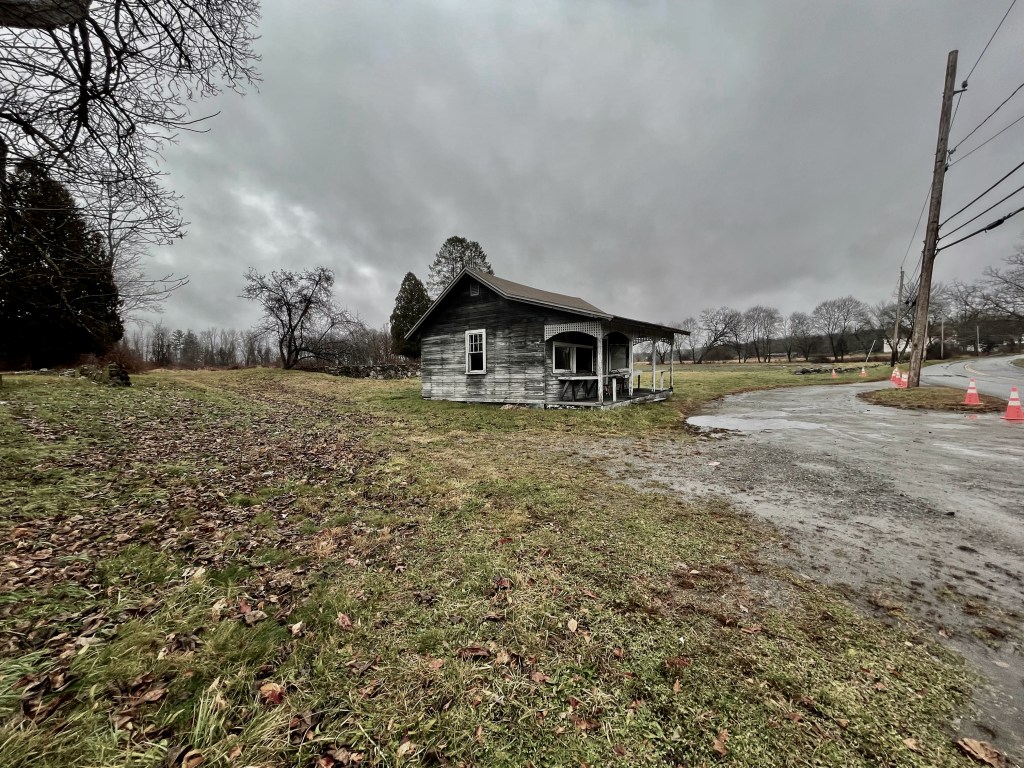
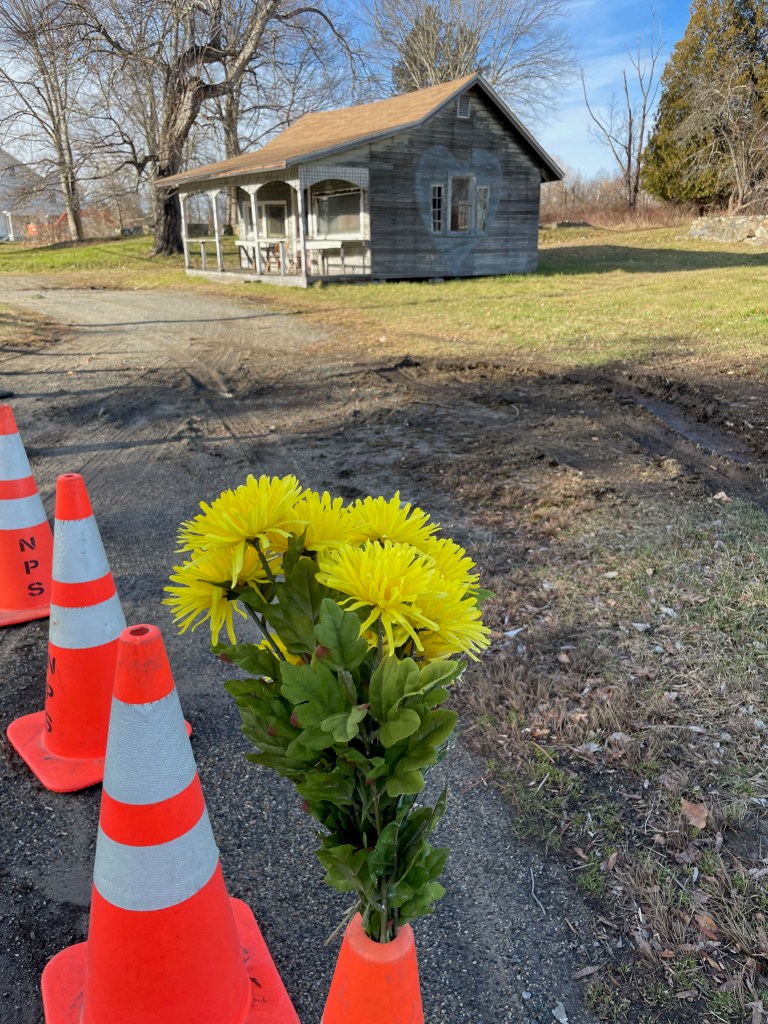
As I kept traveling on Lexington Road, house after house had the orange fencing. Until I reached my favorite little farm stand – the Albano Farmstand. There was no orange fencing. Instead, the circular driveway was blocked off by orange traffic cones. And on the east side of the farm stand, someone had painted a blue heart around the windows. On this gray, dreary day, the heart stood out. But, what did it mean for this building? Was it not going to be rehabbed like all the other buildings on this stretch were going to be? Who drew the heart? What did they know about its future? Why were there now two oak dining room chairs on the porch? Who put those there? Sadly, I drove away, determined to find out more about what was going on.

In the past, I had reached out to the Concord Historical Commission, but never received a reply. I had written to the email address at the Minute Man National Park, but again, no reply. I wrote back to the Park Superintendent and again no response. So, I needed to use my favorite mode of research – social media and back to a Facebook group centered around people who live or have lived in Concord. While some may think social media can be problematic, I believe, it can also be used for research to add a human voice to a story.
So, I put it back out to whether or not people knew if the farmstand was part of the renovations or if its fate was different than the majority of the homes. And once again, the human story of what happened to many of the residents of this area rose to the top.
One person told the story that she believed that her prior family home, that was next to where the infamous Willow Pond Kitchen, is being renovated into a single family dwelling that will be rented out. However, she also spoke of another one of the family’s property that was also a farm where vegetables and fruits were washed and packed, that was now in disrepair because the park let if fall into disrepair. This particular family began farming in this area in the 1920s. Her grandfather and his brothers, who came from Sicily, bought this rather swampy land and created a very fertile vegetable farm despite the naysayers who said that they were crazy to buy such a property. Her family had to move on both physically and emotionally over all this time, but for her, her heart still aches for our lost family farm heritage. She discussed how she and her family were the last residents to be living in our home but my uncle had sold the farm and land to the National Park Service in the late 1960s. This person had been living with her husband and father in her childhood home for five years from 2010 to 2015. After her father died, the National Historic Park showed up with an eviction notice six months after her father died. They left two months later once they found another place to live. The National Park was in a big rush to have control of the property, but since it has, it has done nothing over the past eight years to maintain it. In this person’s case, her father cared for the house and property for 40 years, as it was his own. The family paid the National Park Service rent for all this time, yet, the park service never did any upkeep on the 1850s home.
Another former family member also discussed that it makes her sad that the national park let these houses fall into disrepair. She wished her Grandparents got to see the old house taken care of before they passed away. Such beautiful homes and land with so many amazing memories. This former resident had just driven by and she noted the renovations. I wonder how these residents feel about the homes that are being renovated for some other family that doesn’t have the rich history of the area.
The loss of other buildings and landscapes were also noted. The iconic roadhouse, Willow Pond Kitchen, which stood where there now is a parking lot, was mentioned “I still mourn the Willow Pond. I had many a cheerful meal there. Sometimes I think the NHP oversteps. The Willow pond was an excellent example of a traditional roadhouse. They are slowly or even quickly in many areas being torn down.” The Palumbo Farm was mentioned in another comment: “I still remember the Palumbo Farm. A beautiful natural landscape on that side of town.”Another person noted the changing of the landscape: “Also, I was incredibly sad to see volunteers, cutting down the beautiful (75 year old very long) lilac hedge at the corner of RT2A on Virginia Road right by Shadyside and the farmstand that the park is “reclaiming.”
As I had stated in my earlier blog, it seemed like the agricultural history of this side of Concord was being forgotten, unless it occurred in the 1775 timeframe. This point was not lost on many of the commenters. “Well, they have focused on one time period only. It’s a lesson for us to all learn and act upon. Just as Concord and surrounding areas have just been focused around what occurred around 1775, which is Important yes, in addition there is much history to be learned, honored and made prominent about the indigenous peoples who were here living and honoring the land long before anyone else. There’s also something to be said about the farming that happened after the revolution. Concord was not always the suburb it is today.” Another comment around the importance of having Concord known as just this battle was “ That is a really great point, I hope its brought up in front of policy makers. Concord is more than just the Revolution.”
An interesting point is that now since the 250th anniversary of the Battle of Concord and Lexington is coming, is that the properties are now being fixed up. One comment about this was: “ I’m grateful for the investment NOW being poured into these buildings. But since 2012, when I moved to this side of town, I’ve watched the federal government evict one of the last remaining residents of the homes that they took by eminent domain back in the late 60s and 70s, I’ve watched them boot out a successful farm tenant under the guise of allowing another one to come in (and it’s been many years since then and we have yet to see the farm stand reopen with “new farmers”), and I’ve watched all these homes be allowed to crumble all in the name of historical accuracy, or some such nonsense. We don’t need an inauthentic recreation of what used to be, but rather a living museum, where modern day farmers and families can work alongside some of the historical “witness homes“ that can be fully preserved. I hope the Minuteman park authorities keep up what we’re pouring millions into for a photo opportunity anniversary. But I’m suspicious of the millions being dumped in to cover the benign neglect and I hope more happens once the 250th is done.”
Some of the other comments focused on how they felt that the people now in charge of the park have been more empathetic to the residents who once called this area their home. “I believe the current folks at Concord’s local office are trying to behave in a more thoughtful manner. Despite my feelings of the powers that were in charge of Concord’s NHP in my time frame, those people are no longer in power. From my and my siblings point of view and personal experience now with NHP folks, there exists a more humanitarian approach towards us as former residents. I do feel they are trying to recognize and make amends with us in the ways they are able to.”
But back to the little farmstand with a heart. Some of the comments from this latest post include: “ I pass this house twice a week on my way to the North Shore and just recently noticed two chairs outside the door and coming back today I noticed the heart. I wonder who painted the heart.” Another person commented: “Thank you for posting this. It brought back many memories of visiting that farm when I was young.” Another wrote “I know it’s the old Lou Albano’s Farm. He owned that property as well as several acres across the street about a half mile down a small dirt road. My father and uncles used to hunt on Mr. Albano’s property.” And finally, here is another sweet memory: “I remember Albano’s Farm so well! It was a wonderful vegetable stand. My parents were very good friends with one of the owners. I think his name was Louis. In the 1950s, my mother went into extremely early labor with my sister Joan while picking strawberries in the field there. We used to tease my sister that she was born in a strawberry field! They were a nice family and the farm is a special memory from my childhood.”
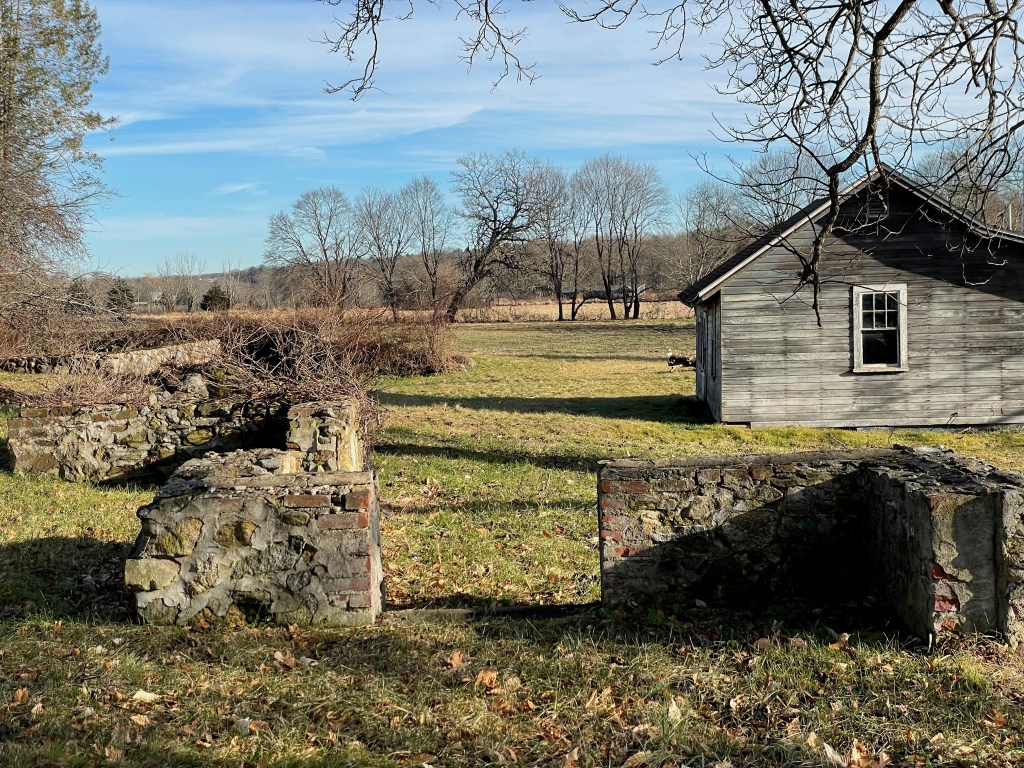
Further research that I just conducted found a memo that discussed the demolition of the Albano Structures (https://parkplanning.nps.gov/document.cfm?parkID=255&projectID=17379&documentID=26388) In this 2009 memo, it discussed the creation of a General Management Plan (GMP) and how the goal of this plan was “selective restoration of the 18th century environment will provide a flavor of the physical conditions on April 19, 1775. To this aim, it is proposed that historical structures dating to the 17th – 19th century be restored on the outside and that many of them be restored for adaptive use. All post 1920 buildings were to be demolished.” This memo specifically addressed the demolition of the Albano House, Garage/Apartment and Produce Stand. The reason for its demolition was stated to be that “the house and produce stand exhibit severe structural deterioration and in their current state pose health and safety risks to MIMA employees and visitors. Additional, mold and hazardous waste issues in the house make occupation or rehabilitation unfeasible.” In this memo was a very thoroughly done table discussing impacts of demolishing the Albano complex on various topics. Under the topic of scenic values, the summary states “The selected alternative from the Draft GMP/EA emphasized the selective restoration of the 18th century cultural landscape. The removal of the Albano structures will contribute to the attainment of that goal. Impacts to the landscape will be minor, long-term and positive.” (p.2 ). Under the topic of Ethnographic Resources, it says “The produce stand was designated as an ethnographic resource because of its association with the farm family that lived in the house, raised produce, and sold it at the stand. The association with the family was lost more than twenty years ago when the family no longer sold produce at the stand. Without association with the farm family, the produce stand is no longer an ethnographic resource.” (p.3). In my prior blog, I had found out that the Concord Historical Commission had approved the demolition of the house and garage but did “ask that the small roadside farm stand remain to preserve the historic rhythm of small farm stands along that section of Lexington Road. The Park has agreed to this request.” (p.80)”
https://concordma.gov/DocumentCenter/View/2506/Historical-Comm-PDF. In 2012, the Historical Commission also wrote in its annual report that they were pleased to see a new roof on the produce stand and that they wrote a letter to the Park’s Superintendent thanking the park service. The Superintendent wrote back saying they were intending to use the produce stand for the Park’s apprentice farming program. Twelve years have passed since this letter and in those twelve years, the little farm stand has been allowed to further decay. With the rush to tidy up the park for the big 250th, is it the hope of the Park to finally demolish what they wanted to demolish in 2009? I have written to a Concord official to see if she could point me in the right direction to find out the answer to that question.
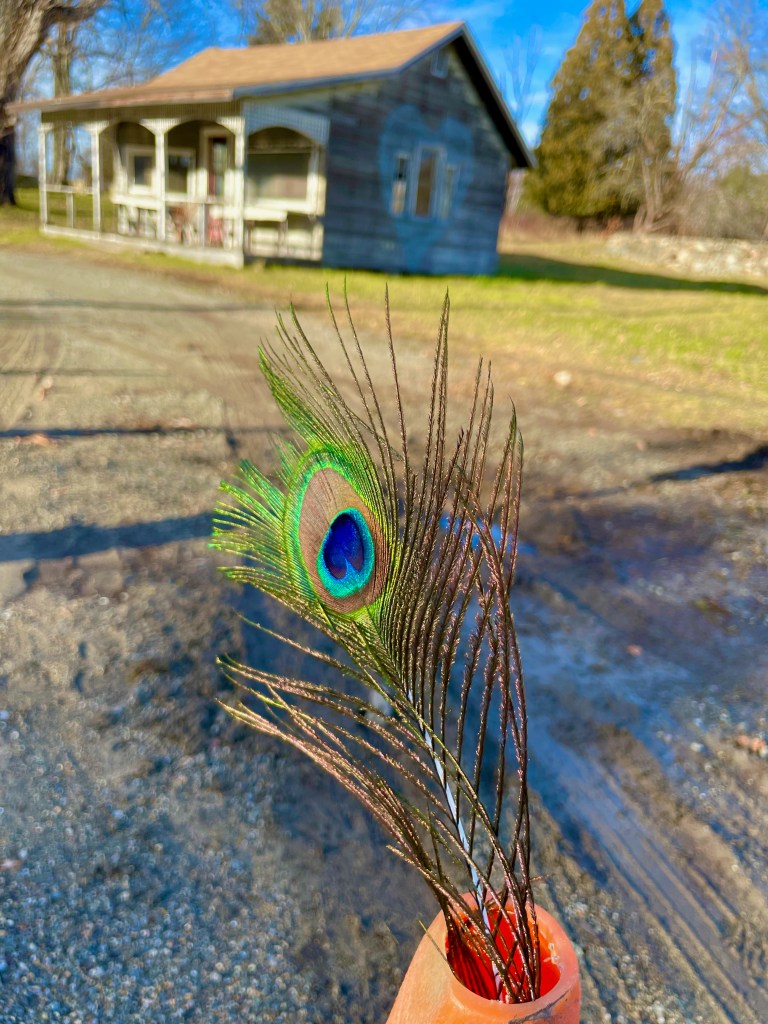
So, I traveled back to the farm stand on December 26th to check if it was still standing. First, work on the Inferrera House and farmstand continues. Work on the older homes continues. As I headed into the curve before the farmstand, my heart first dropped because I did not see it. But, there it was, standing guard to the green and brown fields as it has for a century now. The blue heart had faded a little but matched the brilliant blue sky of this late December day. The orange traffic cones were adorned with fake flowers and a peacock feather. That’s another story for another day.



 Waiting